
AI Outbound Sales Platform
An AI-powered outbound sales platform built with Codex. The source code is no longer available; the method, design rules and build approach are documented here.
An AI-powered outbound sales platform I built with Codex. It turned the outbound method I have used and written up for B2B growth work (a defined customer profile, careful research, personalized messages, a short follow-up sequence and fast human reply handling) into a repeatable system. The original source code is no longer available to me, so this page documents what can still be stated with confidence: the method the platform automated, the rules it was built to follow and how it was built. Nothing here is reconstructed from memory and presented as code.
Project details
- Focus areas
- Revenue Operations · AI Automation · Business Transformation
- Development tool
- OpenAI Codex (primary)
- Status
- Retired: original build no longer available
- Source code
- No longer available
- Version
- Not recorded
- Started
- Spring 2026
- Last updated
- 2026-10-27
Source: not yet linked (unverified)
How to read this page
The platform’s source code is no longer available, so this write-up was made without it and nothing below describes the code itself. Each section says where its information came from. Confirmed means it comes from my own written project goals or from my documented outbound method. Design standard means it is a rule the platform has to meet, not a claim that a feature is built. Unconfirmed marks anything that can’t be checked without the code. No results, volumes, reply rates or meetings are claimed anywhere on this page.
Build an AI-powered outbound sales platform that runs legitimate, human-sounding and highly targeted outreach, and document the build publicly as evidence of how I apply AI automation to revenue operations.
The business problem
Section titled “The business problem”Most outbound programs fail in one of two ways. Some stay manual: a person builds lists by hand, writes every email from scratch and tracks replies in a spreadsheet, so the program never scales past what one person can type. Others scale the wrong way: they buy a large list, send the same template to everyone and burn the sending domain’s reputation within weeks.
Neither creates a business asset. When the person running the program leaves, the knowledge leaves with them, and the domain they used may be damaged.
The approach
Section titled “The approach”Treat outbound as a revenue operations system, not a campaign. The parts of outbound that are repetitive (research, segmentation, first drafts, scheduling, tracking) are good work for AI and automation. The parts that need judgment (who to contact, what is true about them, whether a message is good enough to send and how to answer a reply) stay with a person.
The target outcome is an outbound engine a business owns, documents and can keep running, which is how I approach growth work in general: build infrastructure that stays with the company, not dependency on one operator.
Why it is a portfolio project
Section titled “Why it is a portfolio project”I am positioning my career around business transformation: revenue operations, CRM architecture, AI automation and public-safety technology. This project shows that work end to end, from the go-to-market method to the software that runs it, built with AI-assisted development and documented in the open with its gaps visible.
Constraints
Section titled “Constraints”These are the rules the platform is held to. They come from my project goals and my standing rules for outreach. They are confirmed as requirements. Whether the code enforced each one can’t be confirmed now that the source is unavailable.
- Legitimate outreach only. Every message is sent from an identified person and business, to a real business contact, about a relevant business reason.
- Human-sounding because it is human-reviewed. Messages read like a person wrote them because a person approves them. The goal is not to disguise automation.
- No deceptive tactics to evade spam or AI filters. No hidden text, no misspellings or character swaps to fool filters, no misleading subject lines, no fake reply threads (“Re:” on a first email), no spoofed headers and no rotating throwaway domains to outrun a bad reputation.
- Every opt-out is honored. An opt-out request stops all future email to that address, across every campaign.
- Highly targeted, never bulk. Contacts are chosen against a written customer profile. Volume is a result of fit, not a goal.
- Built with Codex as the primary development tool.
- No client or employer confidential data in the platform’s examples, in this page or in the public repository.
- No prospect data published. No contact lists, names, email addresses or company records appear on this site.
- No API keys or credentials in the repository or on this page.
How the platform works (method)
Section titled “How the platform works (method)”Source of this section
Confirmed as my method: this section comes from the outbound proposals I wrote for a B2B services client in July 2026, with the client’s name, markets, pricing and targets removed. Unconfirmed: how much of each stage the platform’s code automated.
The platform follows the same five-stage method I have documented for outbound programs.
Stage 1. Define the ideal customer profile
Section titled “Stage 1. Define the ideal customer profile”Everything starts with a written profile of who the business serves well:
- Industry and organization type.
- Geographic focus.
- Organization size.
- The decision-maker roles that own the problem, such as facilities, operations or engineering leaders for a facilities-services offer.
- The common challenges those roles face, written in the buyer’s language.
The profile also decides who is not contacted. A contact outside the profile is not worth sending to, however easy it is to find.
Stage 2. Build and verify the prospect list
Section titled “Stage 2. Build and verify the prospect list”Prospects are sourced from a business contact database against the profile. Each record carries only business information:
- Organization name, website and organization type.
- Decision-maker name and job title.
- Verified business email address.
- Business phone and professional profile link, when available.
- Location and employee count, when available.
Email addresses are verified before any send, so the program does not damage its sender reputation with bounces. Personal email addresses are not a target.
Stage 3. Segment
Section titled “Stage 3. Segment”The list is split into segments that share a market and a problem, and each segment gets its own campaign. This is what makes personalization practical: a message for one segment can speak to that segment’s real challenges instead of being written for everyone.
Stage 4. Research, draft and review
Section titled “Stage 4. Research, draft and review”For each segment, and then for each prospect, AI helps with the slow parts:
- Summarizing public information about the organization.
- Matching the organization to the challenges listed in the profile.
- Drafting a first version of each message in the sequence.
A person then checks every claim against the source, edits for tone, and approves or rejects the draft. Nothing is sent without that approval.
Stage 5. Sequence, send and handle replies
Section titled “Stage 5. Sequence, send and handle replies”Each campaign uses a short multi-touch sequence spread over about three weeks:
| Touch | Purpose |
|---|---|
| 1 | Introduction: a personal observation about the organization, a brief introduction and a simple call to action. |
| 2 | Name a common challenge for that role, and how similar organizations handle it. |
| 3 | A relevant example or case story. Only real, approved examples are used. |
| 4 | Educational value: a useful insight for the buyer’s job, with no ask attached. |
| 5 | Final follow-up: restate the value and invite a short conversation. |
| 6 | A polite close that leaves the door open. Optional, for sequences of six. |
Replies are reviewed every day. Interested prospects are qualified and booked for a discovery meeting. Prospects who are not ready are moved to a later follow-up, and anyone who asks to stop is suppressed immediately.
Rollout model
Section titled “Rollout model”New programs roll out in three phases over roughly 90 days:
- Build. Set up the profile, data, sending infrastructure, messaging and documentation.
- Launch. Start with small pilot campaigns, watch deliverability, then grow volume only while the signals stay healthy.
- Optimize. Refine messaging from real replies, document what works, and turn it into standard operating procedures the business keeps.
What the business keeps
Section titled “What the business keeps”The method is built so the business owns the result: documented outbound processes, standard operating procedures, qualification frameworks, campaign playbooks, reporting standards and any custom tools built for it. The platform is the software side of that same idea.
Architecture
Section titled “Architecture”Intended design, not the built architecture
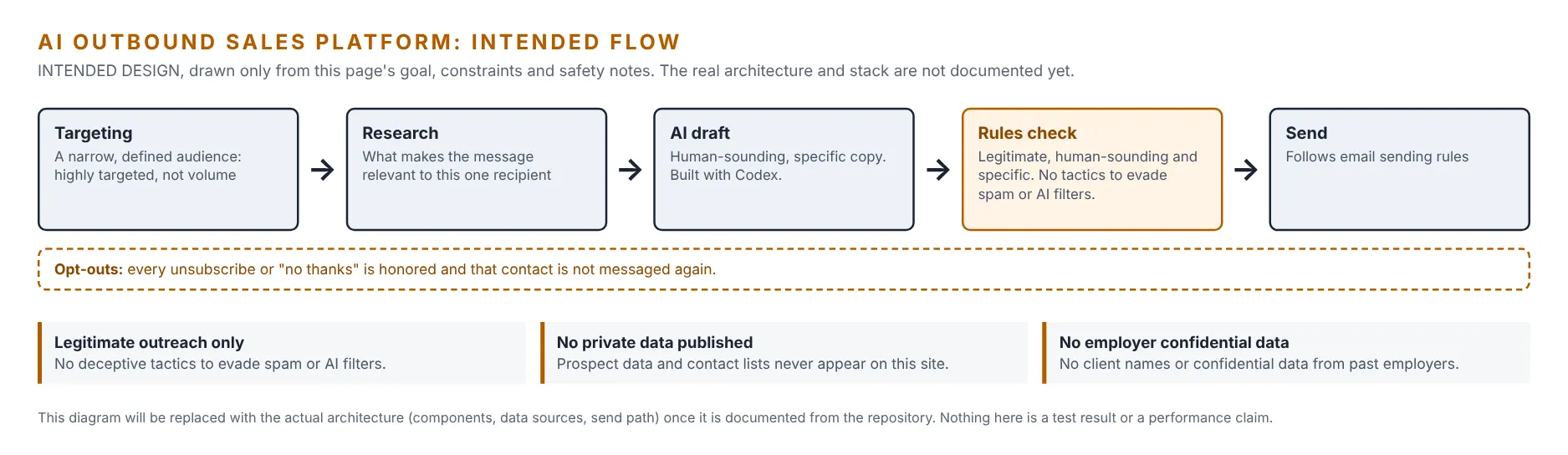
The diagram below is the intended flow, drawn from the goal, constraints and method on this page. It is not the documented architecture. The source code is no longer available, so this diagram stays labeled as intended design.
How the intended flow lines up with the method above:
| Intended stage | Method stage | Who decides |
|---|---|---|
| Targeting | 1 and 2: customer profile, list building and verification | Person sets the profile; tools source and verify |
| Research | 3 and 4: segmentation and organization research | AI summarizes; person checks |
| AI draft | 4: first drafts of each touch | AI drafts |
| Rules check | 4: claim check, tone, compliance items, suppression list | Person approves, with automated checks as a backstop |
| Send | 5: scheduled sequence, reply handling, opt-outs | Tools send on schedule; person handles replies |
The opt-out bar runs under every stage on purpose: a suppressed address must be removed from targeting, never just skipped at send time.
Components to document
Section titled “Components to document”These are the components an outbound platform of this design needs. Because the source is no longer available, what each one was built with is not documented here:
- Data intake and the prospect store.
- Research and drafting (which AI models, and how prompts are managed).
- The review and approval step.
- Sending integration and scheduling.
- Reply handling and the suppression list.
- Reporting.
- Where secrets are kept and how they stay out of the repository.
Deliverability approach
Section titled “Deliverability approach”Design standard
These are the deliverability practices the platform is designed around. They come from my outbound method and from the mailbox providers’ published sender rules. Whether each one was set up or enforced in the platform is unconfirmed.
Deliverability here means earning the inbox by being a sender people want to hear from. It never means tricking a filter.
- Authenticate every sending domain. SPF, DKIM and DMARC are set up on each domain, and the visible From domain aligns with the authenticated one.
- Protect the main business domain. Outreach runs from a dedicated, clearly related domain and a small set of real, named inboxes, so a mistake cannot damage the company’s main email.
- Warm up slowly. New inboxes start with low volume and grow gradually.
- Verify before sending. Bounced addresses hurt sender reputation, so every address is verified first.
- Keep volume low and relevant. Targeting decides volume. A campaign is not scaled up while reply quality or complaint signals are poor.
- Plain, honest content. Accurate subject lines, plain-text-style messages, few links and no misleading formatting.
- Make it easy to leave. Every message offers a clear way to opt out, and opt-outs are processed promptly.
- Watch the signals. Bounce, complaint and reply rates are tracked per domain and inbox, and sending pauses when they turn bad.
Gmail’s published sender guidelines set the bar for the largest mailbox provider: authenticated mail, an easy unsubscribe (one-click for bulk senders) and a reported spam rate kept below 0.3%. The platform is designed to stay well inside those limits. Source: Google, Email sender guidelines. I could not open Google’s page from my build environment on 2026-10-27, so those thresholds come from summaries of it and should be rechecked there.
Compliance stance
Section titled “Compliance stance”Design standard, not legal advice
This section lists the rules the platform is built to follow. It is not legal advice. It does not claim the platform has been reviewed by a lawyer.
In the United States, the CAN-SPAM Act covers commercial email, and the FTC states there is no exception for business-to-business email. The FTC’s compliance guide lists these main requirements, and each one maps to a design rule for the platform:
| CAN-SPAM requirement | Platform design rule |
|---|---|
| Don’t use false or misleading header information | Real From name, real sending domain, accurate routing. No spoofing. |
| Don’t use deceptive subject lines | Subject lines describe the actual message. No fake “Re:” or “Fwd:”. |
| Identify the message as an ad | Messages are open about being a business introduction. |
| Tell recipients where you’re located | Every message includes the sender’s valid physical postal address. |
| Tell recipients how to opt out | Every message includes a clear opt-out. |
| Honor opt-out requests promptly | Opt-outs go to one suppression list that applies to every campaign, and no message goes to a suppressed address. The FTC sets a deadline in business days, which I will quote from the guide when this section is checked. |
| Monitor what others do on your behalf | The business sending the messages stays responsible, even if a tool or vendor does the sending. |
Source: FTC, CAN-SPAM Act: A Compliance Guide for Business.
Other standing rules:
- Business contacts only, chosen for a real business reason that fits the customer profile.
- Other countries have stricter rules. Canada (CASL), the UK and the EU have different consent rules for commercial email. The platform is aimed at US business outreach. Sending to other countries would need its own review first. Unconfirmed: whether the platform blocks or flags non-US contacts.
- Least data. Only the business fields listed in Stage 2 are stored. Nothing from this platform’s data is ever published on this site.
Parts list
Section titled “Parts list”Proposed stack, not confirmed
The services below are the outbound stack I proposed in my July 2026 outbound proposals, and the AI and development tools named in my project goals. Which ones the platform’s code actually connected to is unconfirmed. Prices are left off this page on purpose.
| Part | SKU | Price | Key specs | Source | Status |
|---|---|---|---|---|---|
| OpenAI Codex | TBD | TBD | AI coding agent used as the primary development tool for the platform and its supporting tools | My project goals | Retired |
| Apollo.io | TBD | TBD | Proposed: prospect research and business contact database (Stage 2) | Proposed in my July 2026 outbound proposal | Planned |
| Instantly.ai | TBD | TBD | Proposed: cold email sequencing, scheduling, inbox rotation and campaign analytics (Stage 5) | Proposed in my July 2026 outbound proposal | Planned |
| InfraMail | TBD | TBD | Proposed: dedicated sending infrastructure, about five inboxes per program | Proposed in my July 2026 outbound proposal | Planned |
| MillionVerifier | TBD | TBD | Optional: email address verification before sending | Proposed in my July 2026 outbound proposal | Planned |
| Custom Codex-built tools | TBD | TBD | Proposed: KPI reporting dashboards, automation workflows and efficiency tools for the outbound team | Proposed in my July 2026 outbound proposal | Planned |
| AI model for research and drafting | TBD | TBD | TBD | TBD | TBD |
| Hosting and database | TBD | TBD | TBD | TBD | TBD |
| CRM integration | TBD | TBD | TBD | TBD | TBD |
Configuration
Section titled “Configuration”Not documented. Runtime, dependencies, environment settings, sending limits and suppression-list storage all lived in the source code, which is no longer available. None of them are guessed here.
Build steps
Section titled “Build steps”Install, configuration and deployment steps are not documented, because the source code is no longer available.
How the platform was built
Section titled “How the platform was built”What I can confirm about the build process now:
- AI-assisted development with Codex. I described what each part should do, Codex wrote and edited the code, and I reviewed, ran and corrected it. This is the same way I built my other Codex projects on this site: the ARES CF-33 Field Dashboard, the ARES Duval GIS Command Dashboard and the Vehicle Light Controller.
- The method came first. The outbound method above was written and proposed before the software, so the code automated a process that was already defined instead of inventing one.
Testing and verification
Section titled “Testing and verification”No results are published, and none can be verified now that the source code is no longer available.
Nothing on this page has been verified against the running platform. A rebuild would need to record, with dates:
- Automated test results, and what they cover.
- A check that an opt-out suppresses every later send.
- A check that every outgoing message has the postal address and opt-out.
- Sending domain authentication checks (SPF, DKIM and DMARC).
- A dry run on test inboxes before any real send.
This page will not publish open rates, reply rates, meetings or revenue unless they are measured and I choose to share them.
Safety notes
Section titled “Safety notes”- Follow email sending rules and honor every opt-out.
- Never publish prospect data or real contact lists on this site.
- Never commit API keys, inbox passwords or contact data to the repository. Keep the repository free of real prospect records, even in test files: use clearly fake sample data.
- Use AI for drafts, never for final sends. A person approves each message.
- Never use deceptive tactics to get past spam or AI filters. If a message only works by hiding what it is, it should not be sent.
- Pause a campaign when bounces or complaints rise, and fix the cause before sending more.
Lessons learned
Section titled “Lessons learned”No build lessons are recorded, because the build records went with the source code.
From the method
The outbound proposals behind this project kept coming back to one point: a business should come out of an outbound program owning a documented system, not a pile of sent emails. That is why the platform documents its own process and why this page exists.
Open items
Section titled “Open items”- Source code no longer available. It is not in this site’s repository, my connected GitHub repositories, my Drive, my email or the Codex folder on my Toughbook. The architecture, configuration and build steps stay undocumented, and the diagram stays labeled as intended design.
- If the platform is rebuilt: document the real architecture, the services it connects to, the version, test results and screenshots (fake sample data only), and move it back to In progress.
- Quote the FTC’s opt-out deadline directly from the compliance guide, and recheck Google’s sender thresholds on Google’s own page.
- Confirm how the platform handles contacts outside the US.
Changelog
Section titled “Changelog”Status set to Retired: the original source code is no longer available. The page now documents the method, design rules and build approach in the past tense and no longer promises repository details. Start date set to Spring 2026.
Rollback: Revert the commit that made this change.
Noted that the source code is not available, so the architecture stays documented as intended design.
Rollback: Revert the commit that added this note.
Expanded the page: business problem, method, deliverability approach, compliance stance, proposed stack, build approach, testing plan and open items. Every section is labeled with its source, and unconfirmed items are marked.
Rollback: Revert the commit that expanded this page.
Added the intended-flow diagram.
Rollback: Revert the commit that added the diagram.
Skeleton page published.
Rollback: Revert the commit that added this page.